
Burke Ownership Chain Sources
Former-owner research in Burke County starts with the newest deed. It then steps backward one transfer at a time. Each source reaches a different depth. A tax roll can tell you who was assessed in a given year. Only the deed records, though, document the actual transfers that build a chain of title.
| Source | Years It Covers | Where Held | What It Shows |
|---|---|---|---|
| GSCCCA central index | Displayed 1990 to inspection date | Online GSCCCA | Indexed parties, roles, instrument, and recording reference |
| Post-fire deed books | After the 1856 courthouse fire | Burke Clerk | Earlier transfers and full land descriptions |
| Historic plats | Exact Burke run not verified | Clerk, GSCCCA, archives | Subdivision, lot, road, and replat history |
| Probate collections | Burke segments within 1742–1990 collection | Probate Court, FamilySearch, archives | Estate authority, heirs, and transfer context |
| True Citizen | 1882 to current collection index | Georgia Historic Newspapers | Legal notices, sales, obituaries, deed and plat clues |
Begin online for a recent chain, then carry the last reliable book and page citation to the Clerk. For earlier former owners, add probate and archival sources. Preserve the legal description at every step. Street names and parcel keys change; the description does not. Security deeds, lien releases, plats, and court orders can sit between true ownership transfers. Record them, since they explain burdens and boundary changes. But never add a lender or lien claimant to the former-owner list just because a name appears in the index. Party role and instrument type control the interpretation.
Burke's Online Deed Depth
The GSCCCA real-estate name search indexes Burke County recordings back to January 1, 1990. A separate statewide deed-index milestone is described as January 1, 1999. The two dates mark different layers. Neither promises that every Burke deed image in that span is online. Search last name first. Restrict the county to Burke. Apply party and instrument filters, and narrow the date range when needed. Try initials, spouse names, entity suffixes, estate terms, and spelling variants. The book and page or instrument number is the key for any clerk follow-up. The official GSCCCA property-search screen offers another route into recorded real estate.
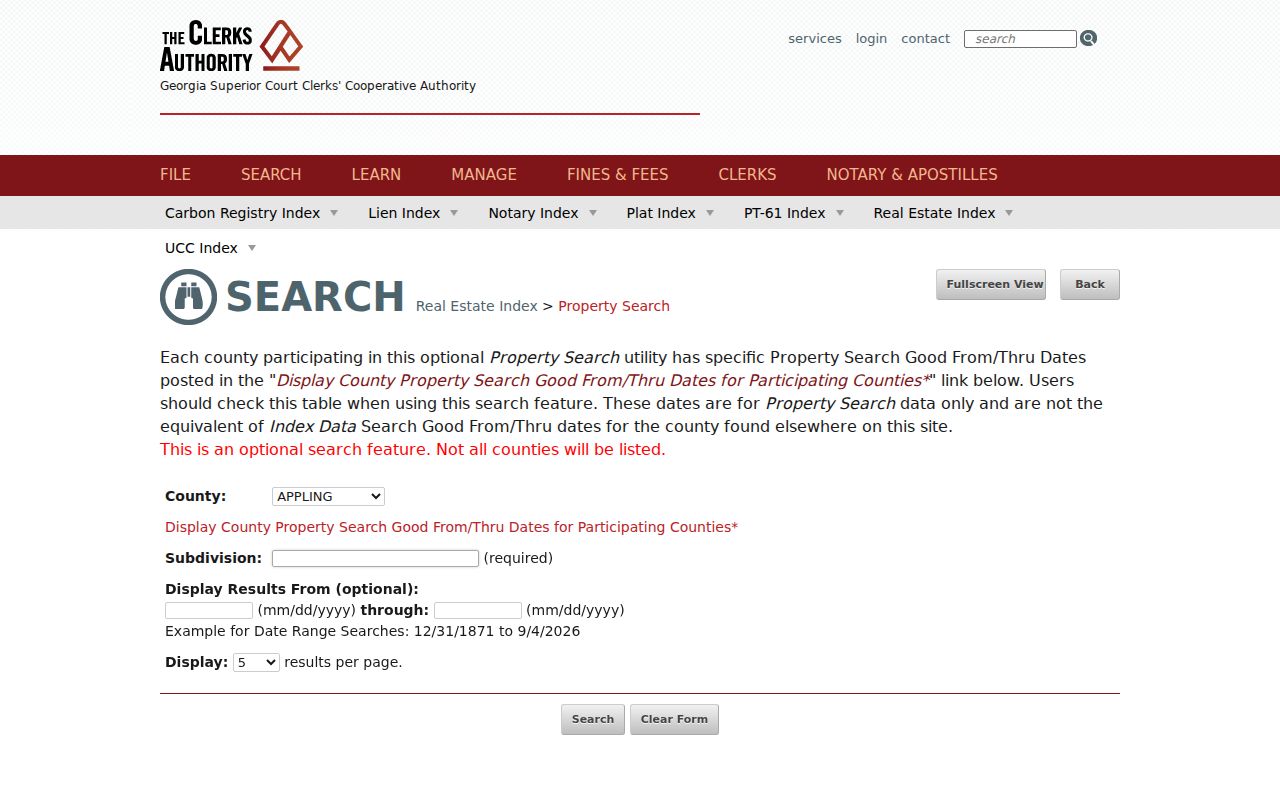
The official search screen lists recorded instruments by name, book, and page. Treat every result as a lead. Confirm the legal description and the deed image itself before counting a transfer in the chain.
Burke's 1856 Record Loss
Fire broke out in the Waynesboro courthouse around midnight on January 24, 1856. Georgia Archives ranks Burke County's losses among the worst in the state. A continuous pre-fire chain may simply not survive. No search of Burke County property records can promise a complete list. It cannot promise early or colonial former owners either.
Time-depth warning. The online index covers a modern layer, while the 1856 fire can leave older gaps that no one database repairs.
Deeds recorded after the fire often point back to an older grant. Some cite a boundary call or a prior book. Headright plats, state land grants, probate files, and tax lists can fill in missing pieces of Burke County ownership chains. Even newspaper notices help too. Each rebuilt link should carry a label marking it as reconstructed.
The fire also shapes how carefully a conclusion should be worded. An earlier deed that has not surfaced is not proof. An earlier owner may still have existed. Name the specific books, probate segments, and archival finding aids behind each claim. When a later Burke County deed cites an earlier tract or owner, quote only the needed description. Then go after the source it names.
Walk Burke Deeds Backward
Start with the current parcel and the newest deed, never an old address. The grantor conveys the interest. The grantee receives it. A reverse index organized by grantee helps you find how a later seller once acquired the same Burke County land.
- Find the newest deed naming the present owner as grantee.
- Copy its grantor, legal description, date, and book/page.
- Search that grantor as a grantee in an earlier period.
- Match lot, block, subdivision, acreage, roads, creeks, and adjoining owners.
- Repeat until the index ends, then continue in physical deed books.
- Grantor and grantee
- The giving and receiving parties indexed on an instrument.
- Chain of title
- The linked series of transfers for the same land.
- Legal description
- Lot, block, acreage, metes-and-bounds, or plat language identifying land.
- Quitclaim deed
- A transfer of the grantor's interest without the promises typical of a warranty deed.
Burke Plats Bridge Prior Owners
A plat reference can hold the chain together long after an address changes. Pull the original subdivision map. Also pull every later phase, replat, lot-line change, road dedication, easement, and vacation. A 2025 notice ties Spring Valley to Lot 21, Section 2-E and Plat File A-5256. A Westgate Phase III notice cites Deed Book 170, page 71 and Plat A-5722. Those notices are leads only. Open the recorded plat and deed. Plantation Subdivision Section I, Burkehaven, and Barrett West offer other local search seeds. For a platted parcel, compare the original map with each later phase and replat. Lots get divided, joined, renumbered, or clipped by a road dedication. The address may stay familiar while the legal parcel changes. That is why a former-owner timeline should carry the deed citation. Do not settle for just a name and year.
Burke Probate Reconnects Owners
Inheritance can break a tidy deed sequence. A Burke County Probate Court file may hold a will, letters, an inventory, a year's-support order, or authority to act. The land event then surfaces later as an executor's deed, a deed from heirs, a partition, or a court order. A death certificate supports identity and date. It does not transfer title. FamilySearch's Georgia Probate Records, 1742–1990 includes Burke segments such as wills from 1856–1931, appraisals and inventories from 1856–1926, and divisions of estates from 1868–1950. Images may require an account or an affiliate-library terminal. The Probate Court publishes no searchable online docket. Counter or phone access to Burke County records still matters.
Burke Archives Extend Ownership
The Burke County Archives occupies a renovated former county jail at 403 Old Herndon Road in Waynesboro. The Burke County Genealogical Society operates it. Its shelves hold county, family, and church material. Much of it predates any online index. The county dates to 1777, when it was cut from St. George Parish, so early Burke County property records lean on parishes, plantations, districts, roads, creeks, and adjoining owners rather than a modern address. Search by all of those landmarks.
Direct office access fills gaps the web leaves open. The Clerk of Court at 200 East 6th Street holds the physical deed books and plats. Deed-book and plat questions go to 706-554-2279. The Archives answers through the county contact line at 706-554-8000, and hours and fees should be confirmed either way. Georgia Archives finding aids, FamilySearch, and Augusta University collections supply further fallback channels. A narrow Georgia Open Records Act request by mail can seek an existing index, roll, or map. It cannot ask staff to create a fresh historical analysis.
Burke Former Owners Have Limits
No complete reconstruction exists for every pre-1856 instrument. Stop at the last supported former owner. Say plainly which source fell short, and treat a Burke County tax roll, census, directory, obituary, or newspaper item as placement only: each can put a person near land, but none alone proves a transfer.
Lawful use. Burke County former-owner research supports house history, estate work, and property diligence; it must not be used to track or harass anyone.
For certified copies or title conclusions, lean on the Clerk of Court and qualified professionals. The Burke County deed records resource covers individual instruments. This method stays fixed on previous owners and time depth.
A final Burke County ownership timeline should separate confirmed transfers from supporting clues. Give each proven link its deed date and citation. Note the clue beside its gap. Probate, tax, newspaper, census, and directory evidence belongs in those notes, never in the proven column, so a likely connection never hardens into a claimed legal transfer.