
Start a Burke Property Search
The fastest Burke County property search narrows from a broad clue to an exact key. The Tax Commissioner's portal accepts Name, Bill Number, Company, Parcel, and Address. Address suits a single known property. Owner or Company can pull up several tax accounts at once, and Parcel becomes the sharpest key once a result reveals it.
- Enter the street number and street name in the tax portal's two Address boxes.
- Open DETAILS and save the Account, Parcel, Description, year, and physical-address clues.
- Carry the parcel to qPublic and compare owner, mailing address, situs, value, and map.
- Use the owner name in GSCCCA to locate the newest deed and related filings.
- Confirm legal conclusions from the recorded document, not the search summary.
Five Burke Tax Search Modes
The Burke Tax Commissioner search loads the tax year on the fly. Name mode offers Starts With or Contains plus an optional first name. Address mode splits the street number from the street name. Bill, Company, and Parcel each rely on a single search box, and results can display 5, 10, 15, 20, 25, or 50 rows.
| Mode | Best use | Input detail |
|---|---|---|
| Name | Person-held accounts | Last name plus optional first name |
| Company | Entity-held parcels | Indexed company name |
| Address | Known site | Number and street in separate boxes |
| Parcel | Exact tax key | Copy punctuation and zeroes |
| Bill # | Known tax bill | Bill number from the notice |
The tax office bills and collects. The Board of Assessors, not the Tax Commissioner, sets appraisal values and answers assessment questions.
Burke Address Search Details
Enter the street number in the first Address field. Put the road name in the second. If nothing appears, try a standard abbreviation or older road wording. The owner's surname or a company name can also work. Burke publishes no one-click search covering every parcel on a street. So a partial address is not a block search. Situs means where the land physically sits. A mailing address is simply where the owner receives notices. A Waynesboro mailing label does not prove city limits any more than an out-of-county address moves the land. ZIP codes are postal geography, nothing more. The property-search screen displays Burke's modes and split address fields.
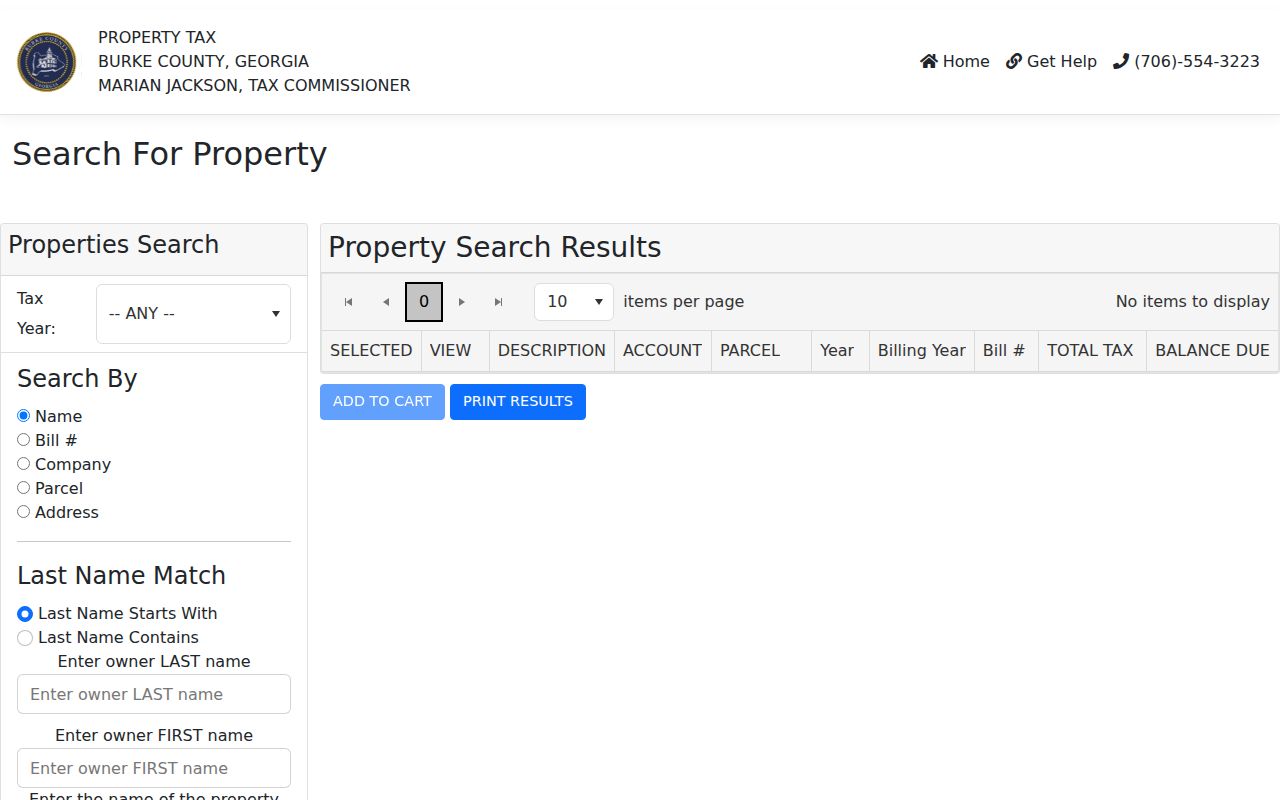
The screen shows the exact entry pattern and the path to the DETAILS result.
Note: Save the returned Account and Parcel before changing modes or opening another record system.
Read a Burke Search Result
The result grid identifies a tax account, not a title opinion. Visible fields include Description, Account, Parcel, Year, Billing Year, Total Tax, and Balance Due. DETAILS opens the account summary, while print and payment-cart controls serve the billing workflow. Keep the Description field in perspective. It may be abbreviated. It is not guaranteed to match the full deed legal description.
| Account | The billing account reference |
|---|---|
| Parcel | The tax and map key to copy exactly |
| Description | A portal label, not necessarily deed text |
| Year / Billing Year | The period represented by the row |
| Total Tax | The charge displayed for that bill |
| Balance Due | The unpaid amount shown by the collection system |
Model fields also include bill number, amount paid, physical address, due date, property type, and internal identifiers. The qPublic parcel card labels, including owner, sketch, value, and sale details, can shift between sessions. Read those fields from the current session rather than assuming their wording.
Move Burke Results to qPublic
Copy the parcel exactly as shown and paste it into the Burke qPublic parcel application. Burke's parcel-number grammar is not documented anywhere public, so keep every punctuation mark and leading zero. Once the parcel resolves, the assessor side layers on appraisal data, exemption details, and parcel-card context as the live session allows.
A gated session is no dead end. Call the Board of Assessors at 706-554-2607 or visit 524 Myrick Street, Suite B, Waynesboro, and provide the parcel number plus the physical address. The counter is a real access channel in its own right, not just a backup for when the portal misbehaves.
Search Burke Owners and Companies
Name mode can gather accounts under one person. Duplicate names and spelling variants still demand care. Try the indexed surname with an optional first name. Initials, a spouse's name, or trust and estate wording also help. Company mode suits an LLC, corporation, church, or other entity. Compare physical addresses and parcels before choosing a row. The Georgia eCorp search can confirm an entity's filed spelling. Its registered agent and office do not prove parcel ownership, though. The newest recorded Burke deed settles the transfer.
Confirm Burke Property in GSCCCA
Search the likely owner in the GSCCCA real-estate index and set County to Burke. Compare party role, instrument type, date, book and page, and legal description. The central index reaches back to January 1, 1990. The service cites a 1999 statewide deed-index milestone. Check county good-from dates and image access for the exact book. A new deed can appear before the assessment roll updates. So the latest deed is the stronger clue to the current transfer. The Burke County deed records page covers the grantor-grantee chain and older-book route.
Note: Try entity suffixes, middle initials, spouse names, and estate terms before concluding a deed is absent.
Recover a Missing Burke Parcel
An empty result can stem from a rural route change, an abbreviation, a historic road name, a parcel split, or a mailing-versus-situs mismatch. Switch keys. Search the owner or company, use a parcel from an old tax bill, or carry a subdivision and lot from the deed into GSCCCA's property search.
- Keep historic spelling and route forms.
- Test an entity with and without its suffix.
- Compare the physical address before the mailing address.
- Ask the assessor to confirm parcel formatting.
- Use deed or plat descriptions for rural tracts.
For older records, the Burke Clerk, Burke County Archives, Georgia Archives, FamilySearch, and The True Citizen can supply the next clue. Cross-check whatever they hold against the same parcel or legal description.
Choose a Burke Search Key
An address matches one spot on the ground. Owner name gathers every account under one spelling. A company key isolates entity-held land, a parcel number ties the tax roll, deed, and plat together most reliably, and a bill number helps only when a tax notice already supplies it. Each search key fails in its own way.
| Search Key | Best For | Where It Works | Watch Out |
|---|---|---|---|
| Address | A specific site | Tax portal and qPublic | Old roads and split boxes |
| Owner name | Person-held accounts | Tax, assessor, GSCCCA | Same names and roll lag |
| Company | Entity-held accounts | Tax portal | Agent record is not title |
| Parcel number | Exact tax/map candidate | Tax portal and qPublic | Unknown format and parcel splits |
Not a title search. A Burke County property search locates public records but does not guarantee clear title, prove occupancy, establish a survey line, or replace qualified title review.
Burke Search Counter Options
The Tax Commissioner takes billing, balance, and collection questions at 706-554-3223. The counter sits at 524 Myrick Street, Suite A. The Board of Assessors sits in Suite B. That office handles parcel cards, values, exemptions, and appeals. For recorded deeds, liens, and plats, go to the Clerk of Superior Court. The Clerk, at 200 East 6th Street, provides terminal, mail, and copy access at 706-554-2279.
A focused Georgia Open Records Act request can pick up where the counters leave off. Name the parcel, account, book and page, instrument, or record type you want. Ask for segregable public portions when a record mixes in protected data. Narrow keys help the custodian find the correct document. They also cut the risk of receiving a namesake's record.
- Parcel
- The tax and map key for a tract.
- Situs
- The physical location of the property.
- Mailing address
- The notice destination, which may be elsewhere.
- Owner of record
- The owner name shown on a public roll at its update date.
Burke Plats and Legal Descriptions
A tax parcel and a recorded legal description do related but different work. The parcel drives appraisal, billing, and mapping. A deed may describe a subdivision lot and block, an acreage tract, or metes and bounds. It may instead cite a prior deed, plat file, creek, road, or adjoining owner. A street address may fail. Those older land terms can then reconnect the current account to the recorded chain.
Search the GSCCCA plat index by subdivision or indexed party. Do this when a result supplies that clue. Dated Burke legal notices offer Spring Valley, Westgate Phase III, Plantation, Burkehaven, and Barrett West as working examples. Treat them as search seeds. The names appear in Burke legal notices. They do not prove current ownership or exact neighborhood limits. Compare the plat file against later replats, road dedications, easements, and lot splits. Also check the deed now tied to the parcel.
The qPublic polygon is only a reference aid. It can orient a tract and its neighbors. It cannot settle a fence line or resolve an overlap. A recorded plat and deed carry stronger legal text. A Georgia-licensed surveyor settles a present boundary on the ground.
Keep Burke Search Evidence Straight
Save the source, access date, exact query, and identifying key for every finding. A tax row covers one bill year. An assessor card shows the roll's update date. A deed index points to a recorded instrument, and a plat depicts recorded land divisions, so never treat one quietly as another.
This discipline matters most after a sale. The recorded deed may update before the assessor owner field catches up. The tax mailing address can lag too. It may still belong to an earlier billing cycle. Compare dates before calling any owner current. When you need a formal title answer, boundary certification, or authenticated copy, carry the saved reference to the responsible clerk or a qualified professional.
Use a short research log when several parcels or names are involved. Record the tax year, result description, account, parcel, physical address, owner spelling, and deed date range. For an entity, note the exact suffix. Keep the SOS registered-agent record separate from title evidence. For a subdivision, save the lot, block, section, phase, and plat file rather than the neighborhood name.
The same care applies to negative results. State that no record appeared under the tested key and range, not that none exists. A web layer may be gated, a spelling may differ, an older book may sit at the clerk, or the courthouse fire may explain a historic break. Call the responsible office with your best parcel or book reference before closing the search. Burke County property search findings are strongest when another reader can repeat them. Exact keys and dates make that possible. They also show when the next step is a certified copy, professional title review, or survey rather than more portal searching. Each record carries its own effective date.